Module 5 Learning Activity: Metaphorically Speaking

            I like to think of education as a “Gate” to the future. This idea comes from the Japanese anime <Doraemon>. In this anime, Doraemon has a “Anywhere Door” called “Dokodemo Door” and it allows Doraemon and other characters to travel to other locations by simply walk through that door. This door acts as a convenient portal and it’s the top 5 thing I wanted when I was a little kid.

Anywhere Door (Dokodemo Door in Japanese, and Anywhere Door in English)

            I chose this metaphor because I believe education can be used as a “Gate to the future” because education provides opportunities for us to learn, explore and thrive on things that interests us and help us build short-term and long-term goals to achieve the self that we dreamed to become.

            I believe it is an appropriate metaphor because it showed a direct illustration of how education’s impacts on people’s lives.

We often think education as the key to open the gate to access great things, to find lifelong pursues. Since metaphors that can shape our perceptions and actions without our ever noticing them. I believe this metaphor emphasized on the importance of education and influenced people unconsciously to take education seriously.

Self Reflection: I chose this topic because I found it very interesting, and I had this “Gate” idea for a long time. As a student grew up in China, I have been told how education is important for people repeatedly and how can change their “fate” through education. Sometimes it sounds exaggerated, but I do agree with the fundamental idea that education does open the “gate” for people to revise their vision of the world. Education connect people to the future and to the help people find lifelong pursue.

Module 4 Learning Activity: MOOCs

https://ocw.mit.edu/courses/18-06-linear-algebra-spring-2010/

The MOOC I am currently taking is the Linear Algebra course taught by Dr. Gilbert Strang. Dr. Strang is a reputable Math professor in MIT. This MOOC is about Linear Algebra. It is hosted by Massachusetts Institute of Technology. The course format used the traditional university course format with sections of Syllabus, Video Lectures, Readings, Assignments, Exams, Study materials and Related resources. There is no interaction with the instructor available as I have the access to all the materials to succeed in this course. I am assessed with 3 exams and one final exam. The answer for each exam is also provided in a separate folder so I can always check my answers after finishing the exam.

The legitimacy of the MOOC is no different than traditional classes. The class itself is published by MIT and hosted by Dr. Strang. The reputation of MIT and Dr. Strang guaranteed the legitimacy of the class. As for autonomy, I have the full access of all the learning materials including video lectures, textbooks, practices questions and test materials. Therefore, I can take the class in my own pace without feel being pushed to do so. I have 0 connection to instructor and peers which I believe is the only disadvantage of this MOOC. Interacting with peers or instructor is crucially important for learning and innovation. The assessment and evaluation are similar with traditional classes that I can do the practice questions, take midterm exams to evaluate my learning progress. My learning experience with this MOOC has been phenomenon. First, the lecture material was very well explained in the video lecture and so far, I have understood everything that Dr. Strang has taught in the video. Secondly, I can always evaluate my learning progress by doing practice questions and to see what my weakness are. Lastly, the structure of the MOOC is very well designed that I never felt overwhelmed by all the learning materials as I was taking some of the classes at UVic.

I would consider this MOOC as xMOOC. It holds the characteristics of traditional classes with similar structures. Although it is professor centred, I still love the way this MOOC is structured as I could focus on my personal improvement without wasting too much time discussing it with peers.

Based on my experience, I would consider this “Open”. I believe this MOOC possess all the characteristics of “Open” as I have the free access to download, reuse and redistribute the learning materials.

Module 3 Learning Activity: Universal Design for Learning

The course outline I modified above is an example of UDL course design. The original syllabus itself was already incorporated with multiple UDL principles. After the modification, the syllabus is focused on the following UDL principles:

  1. Provide multiple means of engagement. The syllabus has provided several ways of accessing course materials including in person lectures and online recordings. Which emphasized on providing learners with choices and autonomies. The syllabus also encouraged learners to form study groups which is a great way of promoting learners’ motivation.
  2. Provide multiple means of Representation. The pop-quizzes, recorded videos and designed course reading provide multiple ways for students to access the course materials. In addition, a list of helpful links related to the course material is also provided in the syllabus to facilitate students’ learning.
  3. Provide multiple means of action and expression. The evaluation of this course is flexible. Students can either take tests or choose their preferred way of evaluating their learning among the nine grading options provided in the syllabus. Students has also been provided multiple ways to get help with their course work including online resources, help from the professor and help from the teaching assistant.

Self reflection

I chose this activity because I really like the idea of UDL, and I think it is such an innovation in learning design. The idea of UDL allows students to dig deeper in the course material and achieve their best potential. UDL also provides students with autonomy and more accessibility, therefore, it allows students who are at “margins” to easily access the learning material. In addition, personally what I found most helpful in UDL is that it emphasizes multiple ways of delivering learning materials thus providing students with more comprehensive understanding.

Reference:

https://udlguidelines.cast.org/

Midterm Critical Self-reflection

My journey with this course has been phenomenon so far. I have gained knowledge through each topic about people-centred learning which I believe is the future of education. In the first module I learned about the fundamental ideas in learning which were Behaviorism (Intended learning behavior can be shaped through positive reinforcement), Cognitivism (view learning as internal mental processes, Focuses on how information is received, organized and retrieved), Constructivism (Propose that learners are constantly “strive for meaning”, create order of the knowledge and the outside world) and Connectivism (Build upon behaviorism, cognitivism and constructivism, emphasizes on the autonomy, connectivity, diversity and openness perspectives in learning). The last one “Connectivism” integrates different entities as whole, the entities include computer networks, social networks, individuals and groups. (Siemens, 2015) points that in connectivism, learning is no longer an individual activity but rather a process of linking specialized nodes and information sources. Connectivism emphasizes on the learning autonomy by altering learning in different approaches.In my opinion, connectivism is definitely the most ideal way for people to adopt, especially in the digital age.

In module 2 I learned about the networked pedagogy, which is similar with the idea “Connectivism”. The networked pedagogy emphasized on providing learners with autonomy and accessibility to information, thus giving affordance to individuals’ learning process and shapes how people engage information and materials. I also explored the importance of instructor’s presence in the learning environment. Even though remote learning is amazing, personally, having instructor’s presence in my learning environment does make me more productive and more engaging to the material.

In module 3, I learned distributed learning, which summarizes the previous module. The distributed learning focused on multi-media methods of instructional delivery. I also learned about UDL which focused on people-centred learning. This idea explains that learning should be focused on individuals rather than information being provided to individual like an object. The UDL allows learners to be the best version of themselves without the feeling of being excluded, it helps learner to learn deeper with more affordances and flexibility. I also learned about the inclusive design. I believe the inclusive design is crucially important for individuals with disabilities or those who are from minority group with less accessibility to the learning material. It recognizes people’s diversity and uniqueness. The inclusive design differs from universal design with more flexible context. I believe having inclusive design in our education system is extremely beneficial and allows individual at the margins have the same accessibility to the learning material.

In conclusion, my journey with this course has been absolutely eye-opening and inspirational. I get to explore different ways of learning as well as designs that helps facilitate students’ learning engagement, accessibility and motivation. And I look forward to the future endeavours in this course.

References:

Bates, T. (2014). Learning Theories and Online Learning. [Blog post].

Siemens, G. “Connectivism: A Learning Theory for the Digital Age. International Journal of Instructional Technology and Distance Learning.” (2005).

Barnes, C.L. (2016). “Where’s the Teacher? Defining the Role of Instructor Presence in Social Presence and Cognition in Online Education.” Humanizing Online Teaching and Learning.

Module 2 Learning Activity: Social Annotation

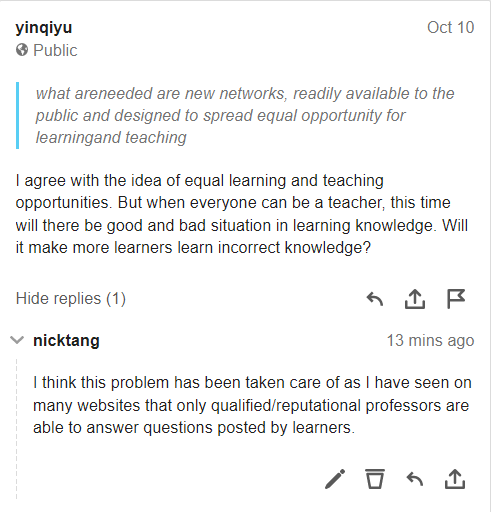
In this learning activity I managed to incorporate annotation in text reading and I found it very helpful. As I read along the paragraphs, the annotated paragraphs was able to provide me key points of the text and making my reading process more focused without my mind drifting away. I was also able to read what my classmates think about certain topics and gain insights through it. I believe this is a form of decentralization that we learners can access the learning material in the environment that fits our own affordance. We are also able to discuss our thoughts, answering others’ questions and everyone who participated in this annotation are able to contribute their own critical thinking about the material, making each other more productive in reading the article.

(Annotation and discussion from Yinqi Yu)

I chose this topic because I have done annotation in my previous psychology class and I think it is a great way of decentralized learning. I found this very helpful in reading long academic articles. The annotation process allows everyone to extract their ideas and takeaways in the article thus students can build concrete ideas on certain topics/definations and have our own understanding of the material, not limited to the text.

Module 1: Theories of Learning

Behaviorism believes that good behaviours can be reinforced through positive reinforcement and inapproriate behaviours can be extinguished by withdrawing reinforcement. I can think of a lot of behaviorism learning as it exists everywhere in our education system. For example, we may get a good grade for the test we studied very hard for, this positive reinforcement is likely to make us keep studing hard for the next exam.

Cognitivism focused on mental processes. One example that comes to mind is that every class has discussions with peers about the things we just learned. During the discussion session, I can reflect what I learned and make sense what I learned with my related experiences. This largely reflected on the idea that human brains are constantly envolving by integrating new knowledge with prior knowledge.

Constructivism proposes that learners are constantly “strive for meaning” and create order of the knowledge and outside world. As a psychology major student, I can relate to this idea about we learned from the scientific research. By firstly ask a question, make hypothesis, decide research design, perform data analysis and draw conclusion. The above steps allows us to solve research questions properly with order, and build a correct scientific mindset.

Connectivism is a theory built upon behaviorism and cognitivism (knowledge viewed as external to the leaner and it is viewed as symbolic mental constructs in the learner’s mind) and constructivism (Assumes learners are actively attempting to create meaning when learning and learning is believed to be a socially enacted process). An example comes to mind is that one of my psychology professor asked us to register in Perusall and then we can all annotate the same academic article, ask questions about specific part of the article and others can answer it. This not only helped us created a connected learning network but also combined technology in learning and made our learning more productive and easier.

I chose this topic because this topic provides a great insight of different ways of learning/teaching, which I believe is beneficial to all of us to explore and fond the right way to learn, teach and communicate. So far I have learned about “learning” from above four perspectives, I believe connectivism is the best way for me especially in this digital era. Connectivism helps us build our personal learning networks, meanwhile combines technologies and different forms of learning together making us much more productive in learning.

Learner Profile

Hello everyone. My name is Nick Tang and I’m a fourth year psychology major student. I’m taking this course as an elective and I’m hoping to learn potential positive outcomes of digital education. As a slow reader, I believe by combining different forms of education in students’ life can greatly increase the productivity.

As a psychology major student. I’m interested in interperson relationships, cognition and neuroscience. I believe this course can provide a great insight in terms of productive learning. I’m a big sports fan I love to play soccer, basketball and tennis. I also enjoy watching UFC and mixed martial arts.

I think group work is a great idea as it allows each member to contribute, exchange their ideas toward a common goal. I enjoy working in groups with equally distributed workload and I’m always happy to contribute more. I don’t usually lead groups as I don’t believe I can make a great team leader. I also enjoy working alone because I believe be able to think independently is crucially important in learning.


Welcome and Introduction

Welcome to your WordPress website for EDCI339. Here are some first tasks to explore with your new site:

  • Go into its admin panel by adding /wp-admin at the end of your blog’s URL.
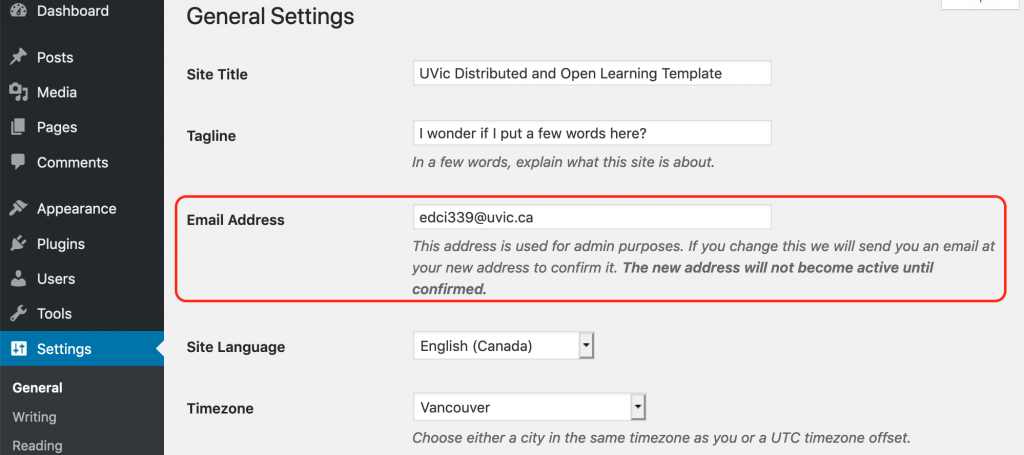
  • Tap “Settings” and change the email address to your email address, then make sure you check your email and confirm the change.

change email address

  • Change the title and tagline for your site under Settings -> General
  • Add new categories or tags to organize your blog posts – found under “Posts” (but do not remove the pre-existing “Distributed & Open” category)
  • Edit the “About Me” or create a new page welcoming visitors to your site.
  • Embed images or set featured images and embed video in blog posts and pages (can be your own media or that found on the internet, but consider free or creative commons licensed works, like found at unsplash.com or pexels.com)
  • Under Appearance:
    • Select your preferred website theme and customize to your preferences (New title, etc.)
    • Customize menus & navigation
    • Use widgets to customize blog content and features

EDCI 339 Test Post

This post  will appear in a few places:

  1. in the blog feed on the front of your website;
  2. in the ‘Distributed and Open’ menu on your website. This is because we have applied the “edci339” category to this post and the menu item “Learning Design” has been created from the category “edci339.” For every post you make for this course, please assign the “edci339” category to it. You are welcome to use this blog for your personal hobbies or for other courses, in which case, you could create additional menu items and categories for them.
  3. if you give permission, your posts categorized “edci339” will be aggregated onto the Blog Feed on the EDCI 339 Course Website.

Please delete this post once you understand this. If you have any questions, please reach out to your instructor.

© 2026 Nick Tang

Theme by Anders NorenUp ↑